

In the modern IT landscape, migration to amicroservice architecture revolutionized software development and release. Often you hear about the challenge between Kubernetes vs Docker, but they are not competing technologies. They represent rather the complementary pillars of an ecosystem cloud-native. To optimize the business infrastructure, it is essential to understand the net difference between containerization and orchestration.
What is Containerization? The Basic Role of Docker
Docker turned software development by eliminating the infamous problem of “it only works on my machine”. As a leading runtime platform, Docker allows developers to package, distribute and execute applications within isolated environments called container.
But what exactly is a container? It is a standardized software unit that contains the source code and all its dependencies, such as bookcases and system tools. This approach guarantees absolute portability and isolation: a Docker container will work identically on the developer's computer, on an on-premise server or in an environment cloud.
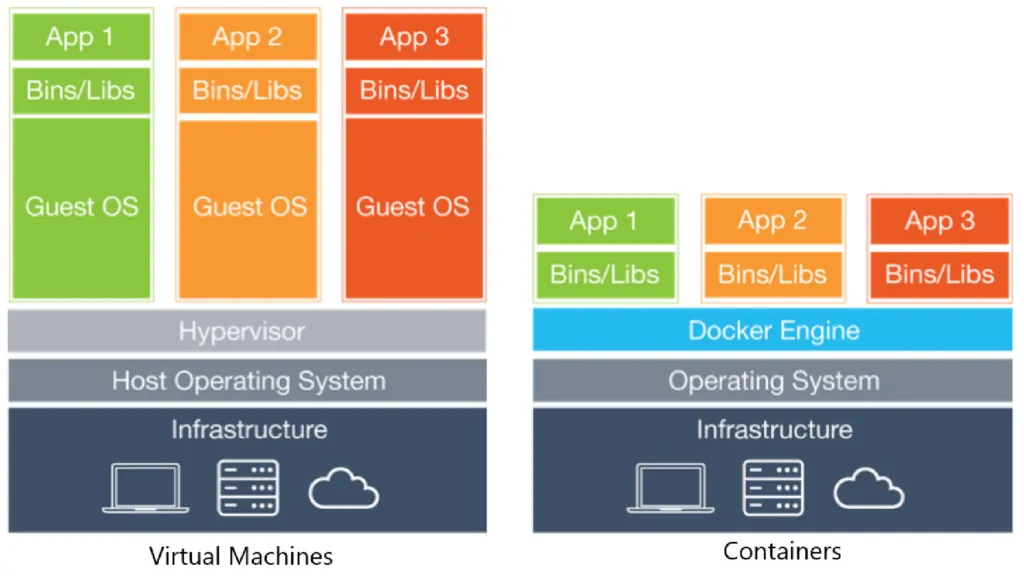
As is evident from the image, the main difference between traditional virtual machines (with a heavy Guest operating system) and container Docker resides in the kernel sharing of the host system, making them much more agile and light.
The central elements ofdocker ecosystem include:
- Docker Engine: The core runtime engine that allows the actual execution of the container.
- Dockerfile and Build: The configuration files essential to define and build the specifications of your software image.
- Docker Hub: The main cloud-based registry container, essential to store, share and download ready-to-use images.
What is the Container Orchestration? The Dominion of Kubernetes
If Docker provides the fundamental “bricks” of modern software, Kubernetes (often known as K8S) is the engineer who organizes and manages the entire infrastructure. When an enterprise-level application scales up to include hundreds or thousands of containers distributed on multiple nodes, manual management becomes physically impossible and is here that theorchestration.
Originally developed by Google, Kubernetes is the main open-source platform for container orchestration. Its primary purpose is to automate the deployment, scaling and operational management of containerized applications, ensuring the maintenance of the desired state through advanced features:
- Service Discovery and Load Balancing: Network traffic balance and intelligent assignment of IP addresses to ensure under load stability.
- Self-healing (Separation): Automatic reboot of containers in error and rapid replacement of nodes that do not respond to health controls.
- Autoscaling: Automatic increase or reduction of number Pod operating in response to CPU or RAM usage peaks.
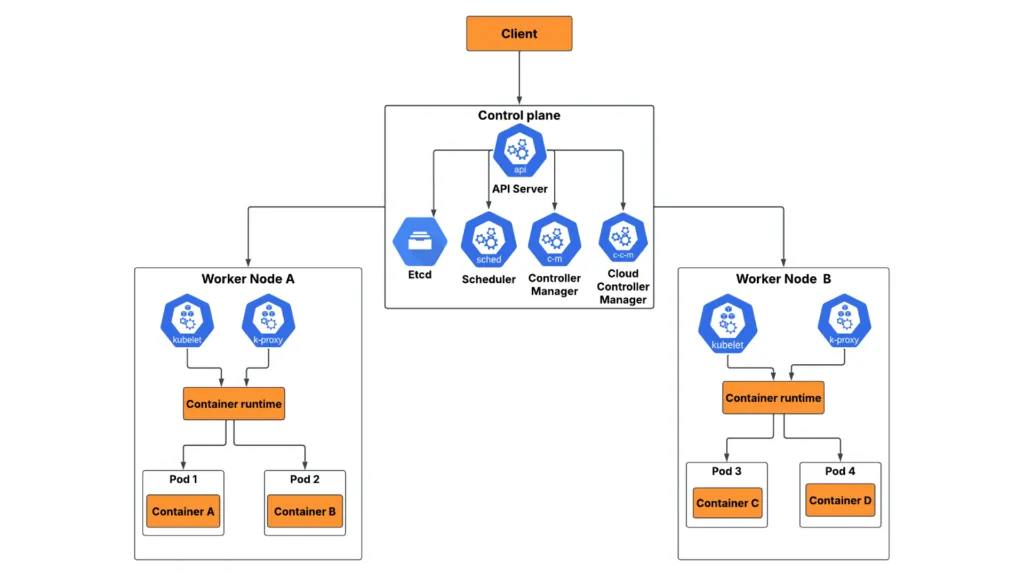
As illustrated in the architectural scheme of a Cluster Kubernetes, the system is governed by a central node called Control Plane, which orchestrates the work of many Worker Nodes. Within the latter, containers generated by Docker are grouped into logical units called Pod.
Kubernetes vs Docker: The Analogy of the Orchestra
To clarify definitively the difference between Kubernetes and Docker, we can use a famous and musical analogue shoe:
- Docker is the single musician: Concentrated solely on the perfect execution of your instrument (microservice). It ensures that notes (code) and tools (free) are used without errors within its isolated location.
- Kubernetes is the conductor: It does not play any instrument directly, but it deals with coordinating the entire ensemble. It declares the time of entry, manages the volume (the allocation of resources) and, if a musician is absent or feels badly (crash of the container system), instantly calls a substitute to ensure that the symphony continues without interruption.
Cloud-Native Integration: Docker and Kubernetes on AWS
In the modern landscape, the implementation of these architectures is widely simplified by cloud providers as Amazon Web Services (AWS). The managed services help companies to break down the systemic complexity of the on-premise orchestration.
To manage container workloads, AWS offers two main enterprise solutions:
- Amazon EKS (Elastic Kubernetes Service): The perfect managed service for those who already have skills on K8s or must migrate multi-cloud workloads. AWS takes charge of maintenance Control Plane, ensuring scalability and safety.
- Amazon ECS (Elastic Container Service): The native alternative of AWS to the Kubernetes orchestration. It is often the winning choice for teams looking for maximum operational simplicity and smooth and deep integration with other Amazon services, without the steep learning curve of K8s.
The Strategic Impact of the Docker-Kubernetes Synergy
In conclusion, the real competitive advantage is not achieved by choosing between Docker and Kubernetes, but exploiting its powerful synergy. While Docker standardizes software life cycle by reducing time time-to-market, Kubernetes ensures that the ecosystem in production is constantly resilient, high availability and extremely scalable.
Adopting the cloud-native approach means turning the IT department: no longer a rigid cost center, but a real dynamic engine for innovation, ready to support business fluctuations and support global applications without compromising on performance.
Frequently asked questions (FAQ)
Does Kubernetes work without Docker?
Yes. Although in the past Docker was the default runtime for Kubernetes, today K8s supports any container runtime compatible with the CRI (Container Runtime Interface) standard, such as containerd and CRI-O.
What is the main difference between containers and virtual machines?
Virtual machines (VM) include an entire host operating system, resulting in heavy and slow to start. The container, instead, share the kernel of the host operating system, offering an almost instant start, greater agility and a substantially lower resource consumption.
When should you use Docker Swarm instead of Kubernetes?
Docker Swarm is the native orchestration instrument of Docker. It is recommended for small or medium-sized projects that require a quick and easy setting. For complex and scalable enterprise architectures, Kubernetes remains the undisputed industry standard.


