Red Star OS: The North Korean Operating System
What is Red Star OS? Discover North Korea's operating system designed for state surveillance, censorship and Kwangmyong internal network.
Red Star OS: The North Korean Operating System #
North Korea is a globally known nation for its isolation and strict control over the dissemination of information. One of the leading technological tools used by the Pyongyang government to maintain this supervision is Red Star OS, a proprietary operating system developed entirely within national borders. This software represents the emblem of the North Korean approach to cybersecurity, reflecting state doctrine in every aspect of its code and network functionality.
Origins and Development #
The Red Star OS project saw light in the early 2000s, with the precise aim of gradually replacing Western operating systems such as Microsoft Windows, which at the time began to spread in the country. The creation of this software fits perfectly in the context of the philosophy juche, the official ideology of North Korean politics that promotes absolute self-sufficiency and national independence in every strategic sector, including technological innovation.

Main Features #
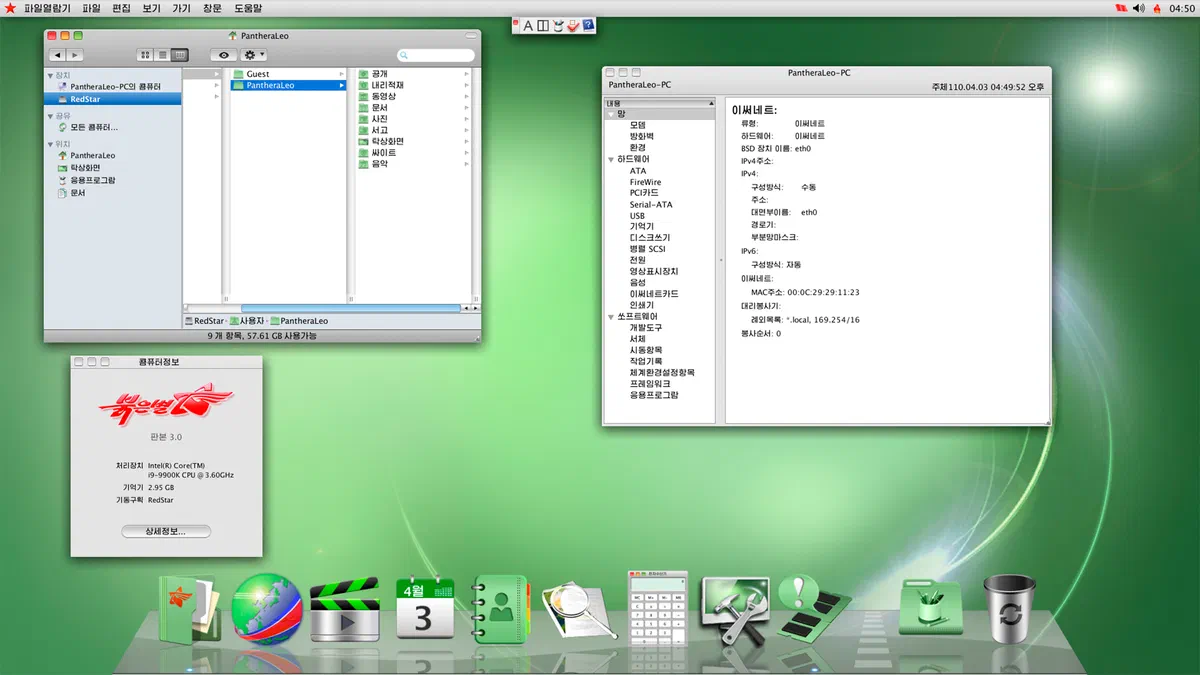
At the level of basic architecture, the system is based on Linux, a technical choice that guarantees wide flexibility and access to numerous open source development tools. Despite this free core, the graphical user interface (GUI) of Red Star OS was radically modified to replicate the aesthetics of macOS Apple. This peculiar choice of web design was probably adopted to offer users a more intuitive, modern and visually appealing digital environment.

- Advanced Control and Censorship: The most controversial feature of Red Star OS is its sophisticated watermarking system. This algorithm injects invisible digital watermarks within each media file or document opened on your computer. Each processed file contains a unique code that identifies the user and hardware, allowing the government to trace the origin and sharing of unauthorized materials.
- Access to Intranet Kwangmyong: North Korea prohibits citizens from accessing the World Wide Web. In its place there is Kwangmyong, a closed national intranet that houses exclusively state portals and websites approved by the regime. Red Star OS is natively pre-configured to interface only with this network, effectively isolating devices from the rest of the digital world.
- Integrated Software Suite: The system includes a pre-installed application package, including a text editor, a multimedia player and a custom web browser (called Naenara). The entire software ecosystem is secured to prevent the execution or download of external programs that could bypass Pyongyang censorship filters.
- System Protection (Root Access): The operating system implements strict restrictions at the level of permits. Standard users have no administrator privilege (root), making it impossible to install non-certified software, modify the registry or disable the background surveillance demons.
Implications for Security and Privacy #
The adoption of Red Star OS raises deep issues related to cybersecurity and privacy. If from a state perspective the system is engineered to arm North Korean government infrastructure against any external cyber attacks, on the other hand it represents the ultimate mass surveillance tool against its population.
The endemic censorship and telemetry continues to be equivalent to the total cancellation of digital privacy. Any operation performed on a terminal equipped with Red Star OS is recorded and sent to centralized servers, eliminating any possibility of free thought, expression or autonomous search of external news.
Comparison with Other Operating Systems #
Unlike the most common commercial Western operating systems, which are based on user experience optimization and user personal freedom extension, Red Star OS is designed to support a diametrically opposite paradigm. While the Windows or Mac user is free to explore the network and customize their workspace, the North Korean user operates in a constantly confined and monitored digital environment.
The absence of administrative privileges and the obligation to connect to the Intranet Kwangmyong alone make Red Star OS a global unicum. In fact, it uses the open code and the potential of the Linux kernel to completely overturn the fundamental principles of cyber freedom and open source sharing.
Final considerations #
In conclusion, Red Star OS is confirmed as the most radical example of how Information Technology can be converted into a real weapon of social repression. Although Pyongyang’s propaganda celebrates it as the ultimate goal of its technological autarchist, the analysis of its source code reveals the architecture of a digital prison.
For cyber security experts and digital rights defenders, this operating system remains a case of study as fascinating as alarming, able to demonstrate the extreme technological consequences of an absolute state control over information.
Frequently Asked Questions (FAQ) about Red Star OS #
What kernel is Red Star OS based on? The North Korean operating system is based on the Linux kernel. Despite exploiting these open source foundations, the operating system was heavily and deeply modified by the government to block free access to the network and insert native state surveillance software.
What is Kwangmyong and how does it interact with the operating system? #
Kwangmyong is the National Closed Intranet of North Korea. Red Star OS is pre-configured through its native browser (Naenara) to allow navigation exclusively within this isolated state network, preventing any connection to the external global web.
Can you install and use Red Star OS outside North Korea? #
Yes, ISO images of different versions of Red Star OS (such as the renowned version 3.0) are leaked over the years and can be downloaded and installed on virtual machines. However, global cybersecurity experts strongly advise against using it on major machines with sensitive data due to aggressive tracking systems and potential backdoors hidden in the source code.