


Curved monitors represent a relatively new technology that is rapidly conquering the most demanding users, overcoming traditional flat monitors. But why upgrade? There are several unique advantages in the design of curved monitors, including reducing eye fatigue and a better field of vision.
In short, the curved monitors are the new flat monitors! At least so it seems, considering the growing number of curved monitor options available on the market, suitable for applications ranging from gaming to work, and even general entertainment.
With a curved monitor, your eyes are immediately attracted by their curved and elegant look, but how do they behave from the performance point of view? Below, we try to compare the curved and flat monitors to discover it. What are the benefits of curved monitors? What about the flat monitors?
Comparison between Monitor Curves and Plates
In the world of visible media, the immersion is a golden standard to which to aspire. If a product can make you forget, so to speak, that you are fixing a screen, it is much more likely that you appreciate the experience.
To create this feeling of immersion, products must be designed to replicate real life. The monitor technology specifically used in this case is called eye perception. This is something everyone learns from childhood.
We see the world in three dimensions: length, width and height. If our collective reality was based only on two dimensions, everything would seem flat. This is where the battle between curved monitors and dishes comes into play.
Curved monitors exploit all three dimensions and expand peripheral vision. On the contrary, the flat monitors, which live up to their name and do not require the use of peripheral vision, offer a weaker immersive experience.
#1 Curved Monitor Advantage: A more immersive experience.
Curve Monitors Eliminate Distortion
Imagine how annoying it is to see a blurred image. Now, consider how you feel when that blur is not due to a poor internet connection, but rather to a hardware problem. In another example, think about how, when you enlarge a video or a photo, the quality undergoes a considerable distortion, especially at the edges.
In the debate between curved monitors and dishes, the above-mentioned situations are almost exclusively associated with flat monitors. Although examples of distortion can occur on screens of any size, they become more common as the size of the monitor increases. Less distortion is one of the benefits of curved monitors than flat ones, since distortion problems are minimized on curved monitors.
There is a simple explanation for this.
The difference between the distortion of curved screens and plates is based on the physics of light projection. In a nutshell, flat screens launch their images straight online, both towards viewers and beyond their sides. The curved screens, on the other hand, exploit their form and direct everything to the viewer, thus limiting distortion.
#2 Curved Monitor Advantage: Less distortion on a curved monitor.
Curve Monitors Are More Comfortable For Your Eyes
The same physics that limits the distortion of curved screens also makes their use more comfortable. Basically, the curvature of monitors allows our eyes to absorb everything at once, effortlessly.
This is opposed to flat screens, which, depending on size, can cause eye fatigue if the screen exceeds the viewer's natural field of view. The ability to grasp a scene effortlessly is something that happens naturally in everyday life.
Being able to perceive the entire curved screen, even in the larger size, your eyes will exploit that natural feeling to stay comfortable. All in all, when considering curved monitors compared to flat ones, keep in mind that your eyes will be able to perform their task more comfortably when you view the first.
#3 Curved Monitor Advantage: Curved monitors are comfortable for your eyes.
Curve Monitors Cover a Larger Visive Field
In the search between curved monitors and plates, it is common that the specifications of curved screens correspond to a greater immersion with a higher field of view. Frankly, this is true for the same reasons why curved screens are also more comfortable than their flat counterparts.
As a curved screen directs the light from all angles to the viewer’s eye, the idea is that you will be able to grasp everything without many eye effort. Therefore, if your eyes are covering a wider field of view more easily than flat screens, the curved monitors will look larger.
An additional benefit of a wider field of view is that it also contributes to your perceived level of immersion.
#4 Curved Monitor Advantage: Curved monitors offer a wider perceived field of view.
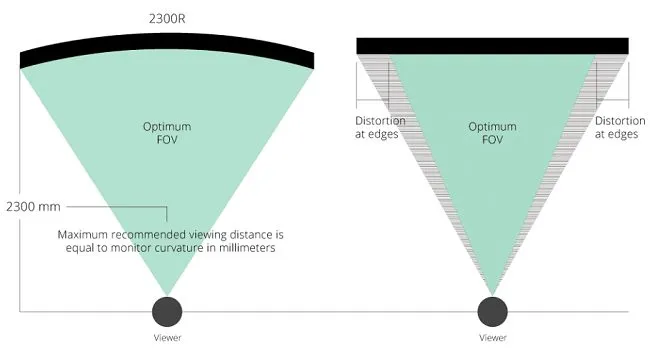
Curves vs. flat screens FOV
Things that will require some adaptation with curved monitors Nothing is ever 100% perfect; there is always a compromise. Although this certainly applies to statements that seem too beautiful to be true, unfortunately it also applies to curved screens.
Fortunately, the disadvantages of curved screens are much less and they will probably not run away from buyers to buy flat screens. Here are some considerations to keep in mind.
Wall mounting
First, because of their shape, curved screens encounter difficulties when it comes to wall mounting. Unlike flat screens, which are typically flush with the adjacent wall, curved screens require specific supports and placements to be mounted.
In general, curved screens require a situation where they are kept away from the wall. Although they do not solve the fact that the curved screens radiate, the tilting and swivel supports and the adjustable arm supports are excellent options to overcome the obstacle of assembly in general.
The good news here is that this is largely a superficial problem and has no impact on performance.
Reflections
Due to the geometry involved in its curvature, a curved screen will unfortunately be prone to reflections when seen from certain angles. Compared to a flat screen, which projects the light in a single uniform angle, the curved screens will do so in numerous corners.
With this in mind, while it is easy to keep away light sources from a single angle, it could become almost impossible to do so when it comes to many angles.
The best way to mitigate this problem is to place the screen away from as many light sources as possible or simply use the monitor with most lights off.
Monitor Curves Ultrawide vs. Plate
A frequent adage is that bigger is better – ultrawide monitors are a testimony of this statement.
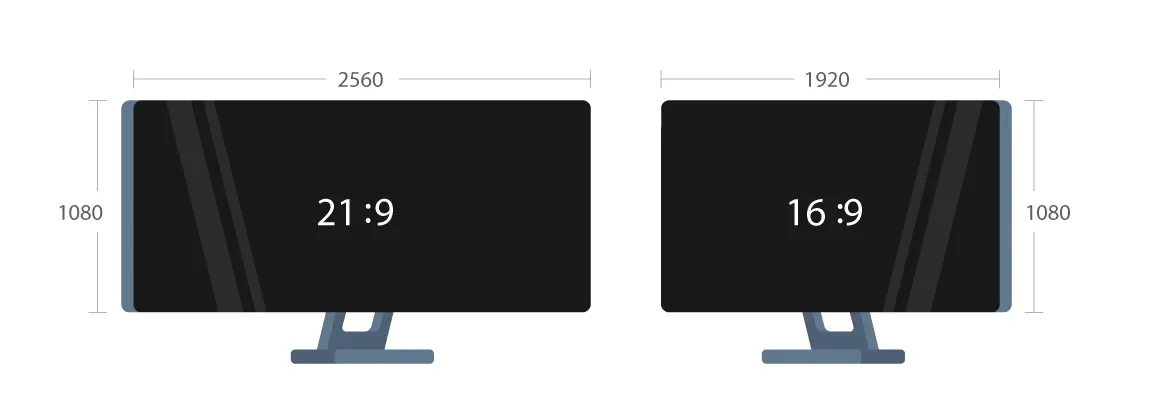
Although monitors have been available in many sizes for a long time, it is a rather recent development that curved monitors have also made their appearance in ultrawide space. These ultrawide curved monitors are different because they use an aspect ratio 21:9 compared to the traditional aspect ratio 16:9.
Ultrawide (21:9) vs. standard (16:9) monitor
As you can see in the image above, the ultrawide 21:9 monitor offers approximately 33% more horizontal screen space than the traditional 16:9 monitor. The ultrawide curve combination fits well and would make sense to opt for an ultrawide curved monitor compared to a normal 16:9 curved monitor. Having the extra horizontal screen space of an ultrawide monitor further accentuates the benefits of the curved monitors we described above.
In addition, for those who need multiple displays for work or play purposes, ultrawide monitors will prevent the use of another screen. As for the game, some games even support the ultrawide aspect ratio 21:9, offering all the benefits of a curved gaming monitor and an extensive field of view at stake!
To learn more about the advantages of an ultrawide monitor, see this ultrawide and double monitor comparison article. In some situations, this change could help increase productivity and efficiency, as well as free extra space on your desk and power outlets. Or discover the Curved ViewSonic monitor collection here.


