

In the context of modern IT, the transition from monolithic architecture to microservices has redefined the way software is developed and distributed. In this context, Kubernetes and Docker emerge not as competing technologies, but as complementary components of an ecosystem cloud-native. To understand how to optimize an IT infrastructure, it is essential to clearly distinguish the roles of these two technologies: containerization and orchestration.
The role of Containerization: Docker.
Docker revolutionized software development by solving the classic problem of “works on my machine but not in production”. Docker is a runtime technology that allows developers to create, deploy and run applications within container.
A container is a standardized unit that packs the code along with all its dependencies (books, runtimes, system tools). This ensures process isolation and absolute portability: a Docker container behaves exactly the same on a development laptop, on an on-premise server or on a cloud instance.
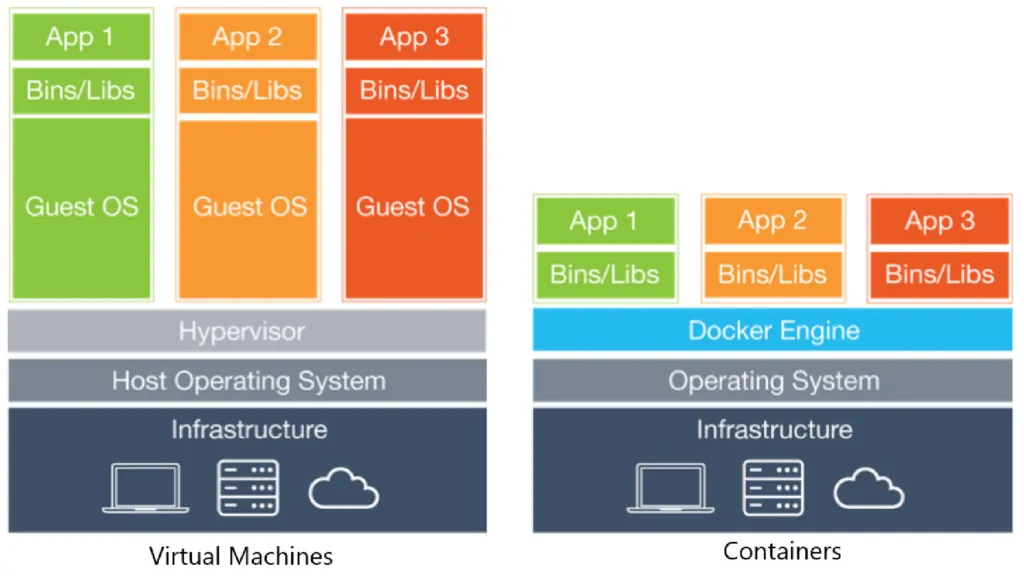
A layered diagram showing the difference between “Virtual Machines” (with heavy Guest OS) and “Containers” (which share the host kernel via the Docker Engine).
Docker ecosystem key tools include:
- Docker Engine: The engine that makes the execution of the container possible.
- Dockerfile and Build: The commands to define the specifications of the container image.
- Docker Hub: A register to share and retrieve images, similar to a code repository.
The need for the Orchestration: Kubernetes
If Docker represents the fundamental “matton”, Kubernetes (often abbreviated to K8s) is the architect who uses those bricks to build and manage complex structures. When an enterprise application consists of hundreds or thousands of containers distributed on different servers, manual management becomes impossible.
Kubernetes is an open-source orchestration platform that automates the operating operations (Ops) of the container. It is not limited to performing the application, but guarantees the desired status through:
- Service Discovery and Load Balancing: Intelligent distribution of network traffic between containers.
- Self-healing: Automatic reboot of containers that fail or replace unresponding nodes.
- Automatic Scaling: Increase or decrease in the number of active containers (Pod) depending on the load of the CPU or memory.
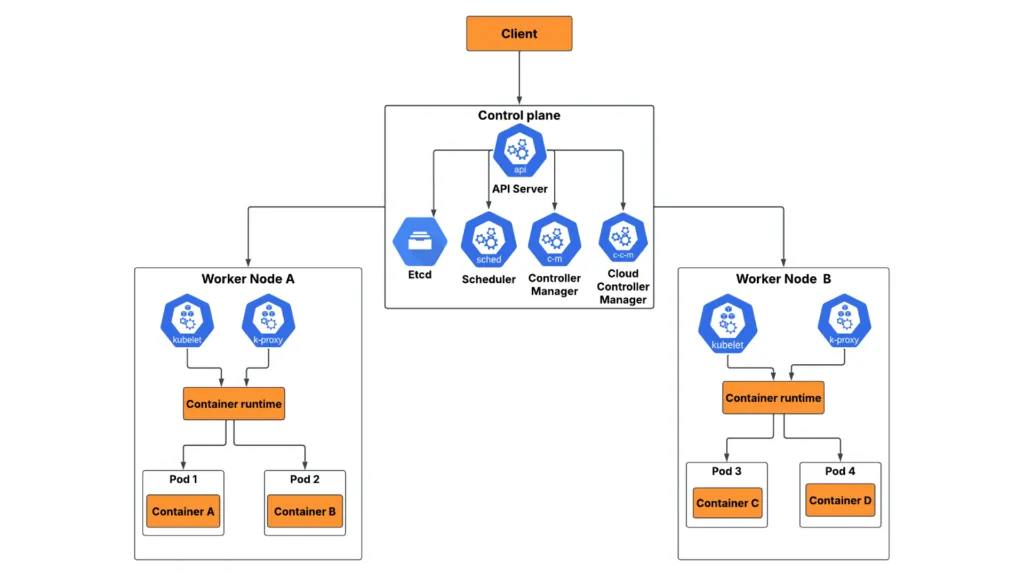
An architectural scheme of a Cluster Kubernetes. In the center the “Control Plane” (the brain) that manages several “Worker Nodes”, within which you see multiple Docker/Container icons grouped in “Pod”.
A functional analogy: The Orchestra
To better view the difference, you can use the musical analogy.
- Docker is the musician: It is focused on the performance of the single instrument (microservice). Make sure your part is done perfectly, with the right tool and score (free and code).
- Kubernetes is the conductor: It does not play the instruments, but it coordinates the whole group. He decides when a musician has to start playing, how much volume (resources) he has to use, and if a musician is sick (systemcrash), he immediately calls a substitute for not interrupting the symphony.
Cloud Integration and Management (AWS)
The adoption of these technologies is often facilitated by cloud providers such as Amazon Web Services (AWS), which offer managed services to reduce infrastructure complexity.
Companies can choose from two main routes on AWS:
- Amazon Elastic Kubernetes Service (EKS): Ideal for those who already have skills on Kubernetes or need to migrate workloads from other K8s environments. AWS manages the complexity of the control plan, ensuring high reliability.
- Amazon Elastic Container Service (ECS): An alternative solution to Kubernetes, strongly integrated into the AWS ecosystem. ECS is often preferred for its operational simplicity when the extreme customization features of Kubernetes are not required.
The Strategic Impact on IT
The real power of a modern architecture is not in the choice between Docker and Kubernetes, but in their combination. Docker standardizes software release, accelerating time-to-market for developers. Kubernetes ensures that the software is resilient, scalable and efficient from the resource perspective for the operating team.
Adopting this synergy means turning IT from a static cost center to a dynamic asset, able to adapt in real time to business needs and support globally distributed applications with previously unreachable availability levels.


